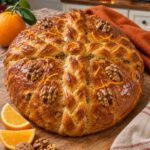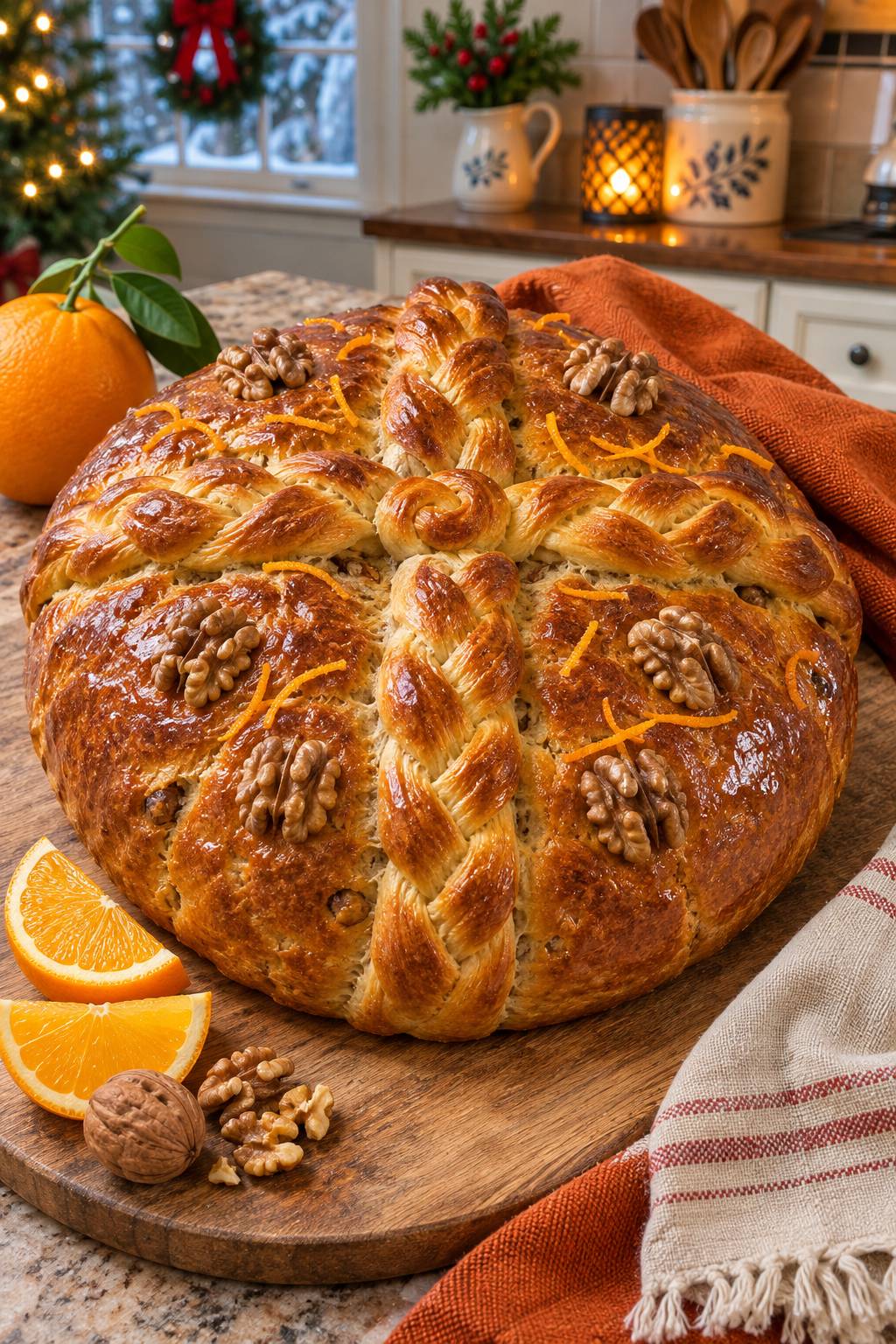
There is something special about a loaf that fills the kitchen with orange and cinnamon while the rest of the holiday meal comes together. This Greek Christmas bread is slightly sweet and enriched, with orange zest and juice in the dough and chopped walnuts in every slice.
Because the dough is enriched with eggs, butter and sugar, it bakes up softer and richer than a plain lean loaf. It rewards a little patience, so read the dough by look and feel rather than the clock, and you will end with a handsome braided round.
Why the Orange Sugar Matters
Rubbing the zest into the sugar with your fingertips is a small step with a big payoff. The oils in the peel release into the sugar, which turns moist and fragrant and carries that bright flavor through the entire loaf. When you zest, grate only the colored outer layer. The white pith underneath is bitter and can dull the sweetness. The juice adds moisture and a gentle citrus note, and it should be at room temperature so it blends smoothly with the other ingredients.
Handling the Dough with Confidence
Yeast is the most temperamental part of this bread, so aim for milk that feels comfortably warm rather than hot. Liquid that is too hot can harm instant yeast, while cooler liquid slows the rise. Add the butter a few pieces at a time, and add flour gradually, stopping once the dough is soft and slightly tacky.
Kneading builds the structure. As you work the dough, the gluten develops and traps the gas from the yeast, which is what lets the loaf rise. Look for a dough that is smooth, elastic and pulls cleanly from the sides of the bowl. If it still clings and tears, keep kneading a little longer.
Walnuts, Braiding and the Glaze
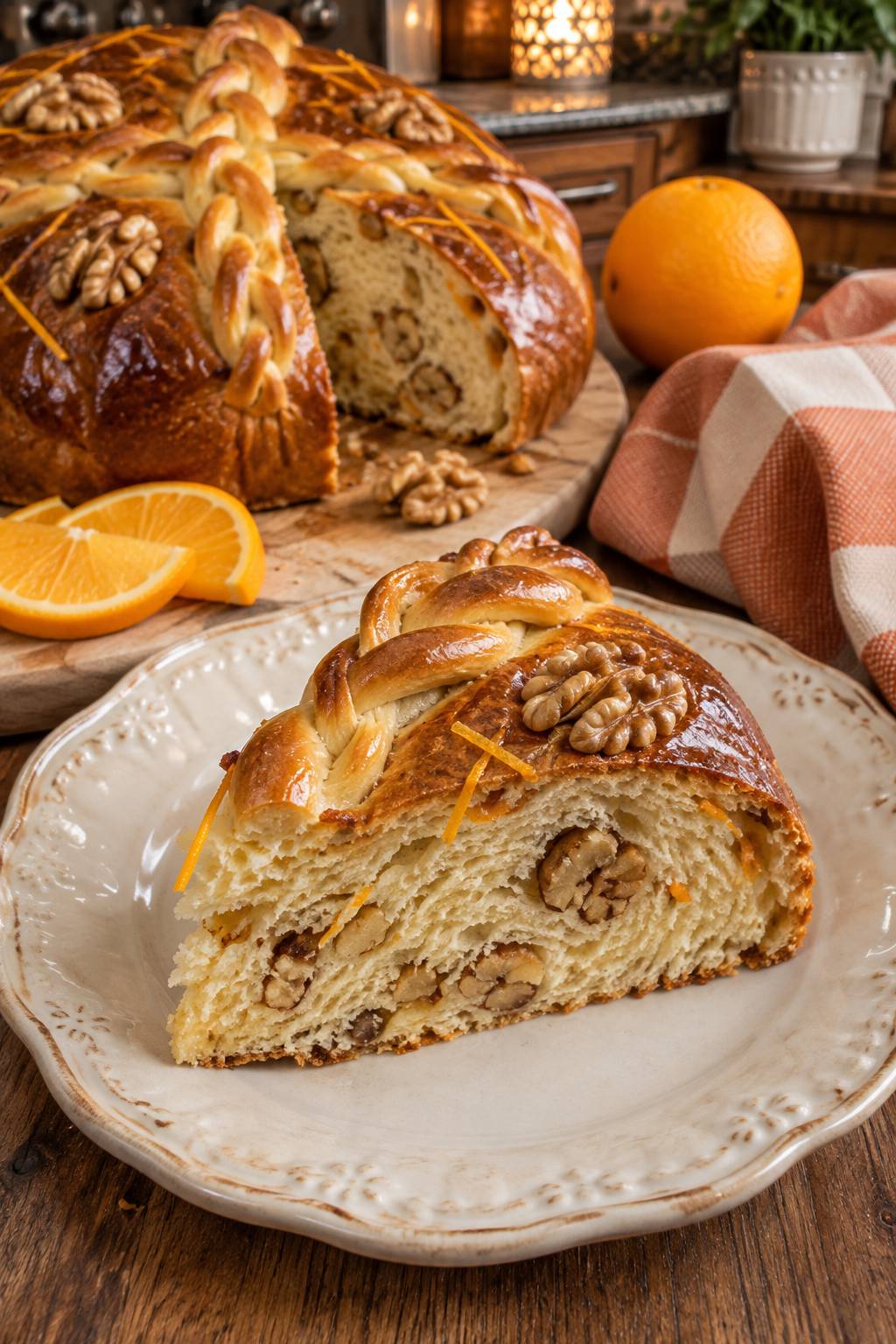
Toasting the walnuts in a dry skillet deepens their flavor, so they taste rich rather than raw once baked. Watch them closely and stir often, then cool them before chopping finely so the pieces spread evenly through the dough. When braiding, keep the ropes an even size and pinch the ends firmly. The egg wash gives the crust its golden color, while the walnut halves and orange peel strips adhere to it before baking. The honey and orange glaze goes on while the loaf is still hot, so it soaks in and gives a glossy top.
Avoiding Common Mistakes
The most frequent problem is a top that darkens before the center is done. Enriched doughs brown faster than lean breads, so if the crust darkens too quickly, loosely tent the loaf with foil. Check the center with an instant-read thermometer rather than trusting color alone. Afterward, be patient: cutting into a hot loaf can leave the crumb gummy, so let it cool on a wire rack until the slices hold their shape.
Frequently Asked Questions
Why does my dough feel sticky, and should I add more flour?
A soft, slightly tacky dough is what you want for this recipe. Add the remaining flour only as needed, a little at a time, and stop once the dough is smooth, elastic and pulls cleanly from the sides of the bowl. Too much extra flour makes the loaf dense.
Why does the top darken before the center is baked through?
Eggs, butter and sugar make enriched dough brown faster than lean bread. Loosely tent the loaf with foil if the top darkens too quickly, then check the center with an instant-read thermometer and bake until it reaches the target listed on the recipe card.
When is the right time to brush on the orange honey glaze?
Brush the glaze over the loaf as soon as it comes out of the oven, while it is still hot, so it soaks into the top. Warm the honey and orange juice until smooth before brushing. Let the loaf cool on a wire rack before slicing so the crumb can set.
Greek Christmas Bread with Walnuts and Orange
12
servings40
minutes40
minutes380
kcal4
hoursA slightly sweet, enriched yeast bread flavored with orange zest and juice, studded with chopped walnuts, shaped into a round braided loaf and topped with walnut halves and orange peel strips. It is glazed with egg wash before baking and brushed with orange honey glaze when it comes out of the oven.
Ingredients
- Dough
1 cup whole milk, warmed to 110°F
1/3 cup fresh orange juice, at room temperature
2 1/4 tsp instant yeast (1 packet)
1/2 cup granulated sugar
2 tbsp finely grated orange zest (from 2 oranges)
4 1/2 cups all-purpose flour, plus 1/4 cup for dusting
1 tsp kosher salt
1/2 tsp ground cinnamon
2 large eggs, at room temperature
1/2 cup (1 stick) unsalted butter, softened and cut into pieces
1 tbsp unsalted butter, softened, for greasing the bowl
- Walnuts and orange
1 cup walnut pieces
12 walnut halves
Peel of 1 orange, removed in wide strips with a vegetable peeler and cut into thin strips
- Egg wash and honey glaze
1 large egg, beaten with 1 tbsp whole milk
2 tbsp honey
1 tbsp fresh orange juice
Directions
- Dough
- In a large bowl, rub the orange zest into the sugar with your fingertips until the sugar is moist and fragrant, about 1 minute.
- In the bowl of a stand mixer fitted with the dough hook, combine the zesty sugar, 2 cups of the flour, the yeast, salt and cinnamon. Add the warm milk, orange juice and eggs. Mix on low speed for 1 minute.
- Add the butter a few pieces at a time, mixing well after each addition. Add the remaining flour 1/2 cup at a time until a soft, slightly tacky dough forms. Use only as much of the remaining flour as needed.
- Knead on medium-low speed for 8 minutes, until the dough is smooth, elastic and pulls cleanly from the sides of the bowl. Kneading develops the gluten that traps the gas from the yeast and gives the loaf its structure.
- Grease a clean large bowl with the softened butter. Shape the dough into a ball, place it in the bowl and turn it once to coat. Cover with plastic wrap or a clean towel and let it rise in a warm spot for 90 minutes, until doubled in size.
- Walnuts and orange
- While the dough rises, toast the walnut pieces and the walnut halves in a dry skillet over medium heat for 5 minutes, stirring often, until fragrant and a shade darker. Let cool, then chop the walnut pieces finely.
- Shape and bake
- Punch the dough down and turn it onto a lightly floured surface. Flatten it into a rough rectangle, scatter the chopped walnuts over it, and knead gently until the walnuts are evenly distributed, about 1 minute.
- Cut off about one-third of the dough and divide it into 3 equal pieces. Roll each piece into a 14-inch rope and braid the ropes together, then pinch the ends to seal.
- Shape the remaining dough into a smooth ball, tucking the seam underneath. Place it on a parchment-lined baking sheet and flatten it slightly into an 8-inch round. Lay the braid across the top of the round, bending it at the center, and tuck the ends underneath the dough.
- Cover loosely and let the loaf rise for 45 minutes, until puffy. Meanwhile, preheat the oven to 350°F with a rack in the center.
- Brush the loaf all over with the egg wash. Press the walnut halves and orange peel strips evenly over the top so they stick to the glaze.
- Bake for 35 minutes, until deep golden brown and an instant-read thermometer inserted into the center reads 190°F. If the top darkens too quickly, loosely tent it with foil for the last 10 minutes.
- Warm the honey and orange juice in a microwave for 15 seconds and stir until smooth. Brush the glaze over the hot loaf, then transfer the loaf to a wire rack and cool for 30 minutes before slicing.
Notes
- Warm the milk to about 110°F. Hotter liquid can kill instant yeast, and cooler liquid slows the first rise.
- When zesting, grate only the colored outer layer. The white pith underneath is bitter.
- Enriched doughs with eggs, butter and sugar brown faster than lean breads, so loosely tent the loaf with foil for the last 10 minutes of baking if the top darkens too quickly.
- Let the loaf cool for at least 30 minutes before slicing so the crumb can set and the slices hold their shape.