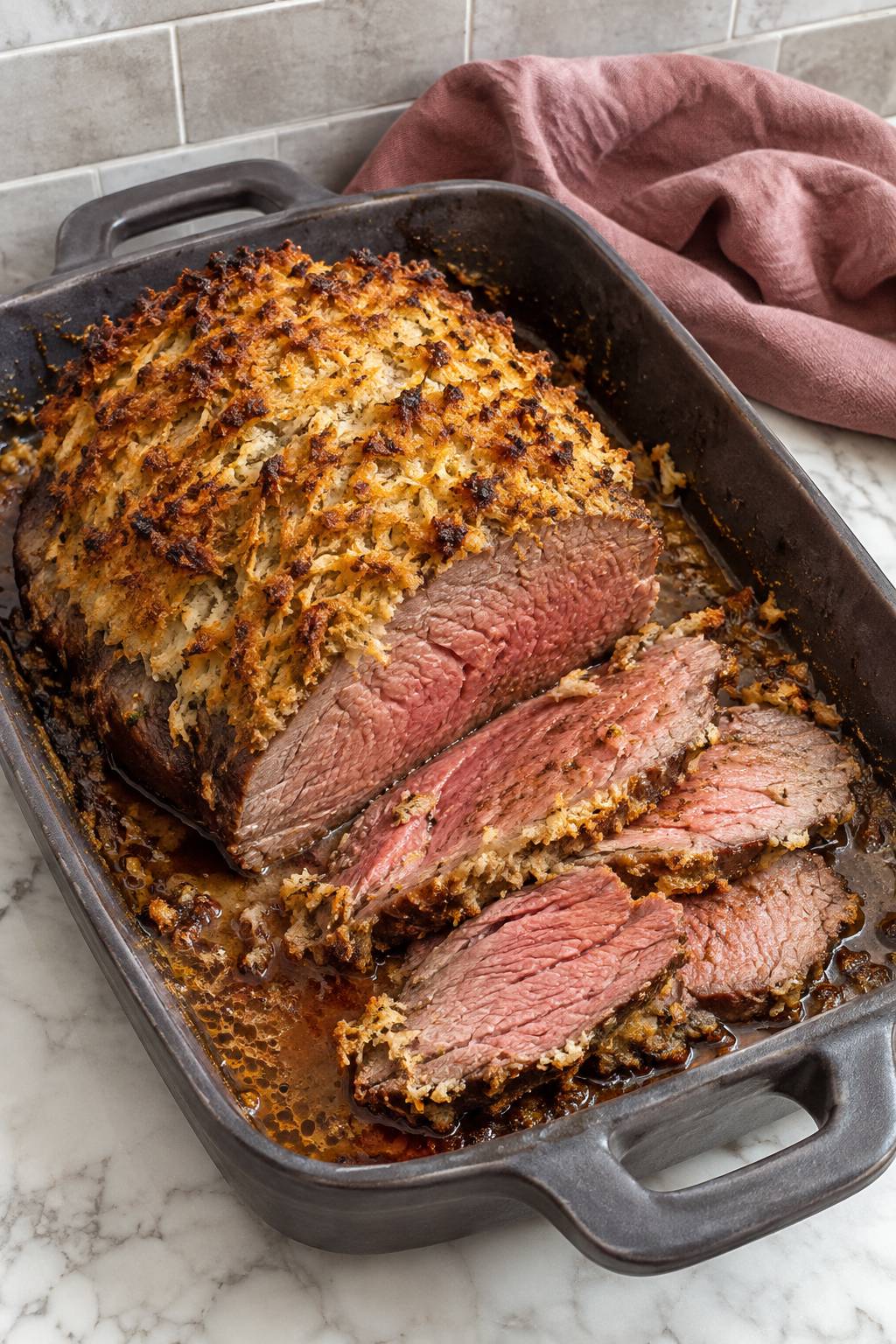
A horseradish crust gives boneless beef top sirloin a bold, savory finish, while buttery breadcrumbs turn golden in the oven. Dijon mustard ties the sharp horseradish to the crisp topping, and the beef broth in the pan picks up the roast’s juices.
The key to a good result is paying attention to the roast’s shape and checking its center with an instant-read thermometer. That helps you judge doneness accurately while keeping the breadcrumb crust intact.
Build a coating that holds together
Prepared grated horseradish brings the coating’s characteristic bite. Use the grated kind rather than creamy horseradish sauce, and drain it well before mixing it with Dijon mustard. Excess liquid can make the coating runny and keep the crumbs from adhering.
Panko breadcrumbs give the topping a light, crisp texture. Softened unsalted butter helps moisten the crumbs evenly, while minced garlic, fresh parsley, and dried thyme add savory flavor. Mix until the crumbs are evenly coated, then press them firmly over the mustard mixture so the topping stays in place.
Protect the crust as the roast cooks
Patting the beef dry helps the olive oil, kosher salt, and ground black pepper coat its surface. Set the roast fat side up in a metal roasting pan. During the initial uncovered roasting, the beef begins cooking before the horseradish and breadcrumb layers go on.
When you add the broth, pour it into the bottom of the pan and keep it off the crust. The liquid provides warm pan juices for serving, while keeping the crumb topping dry enough to brown. If the top becomes deeply browned before the center reaches your target temperature, loosely shield it with foil.
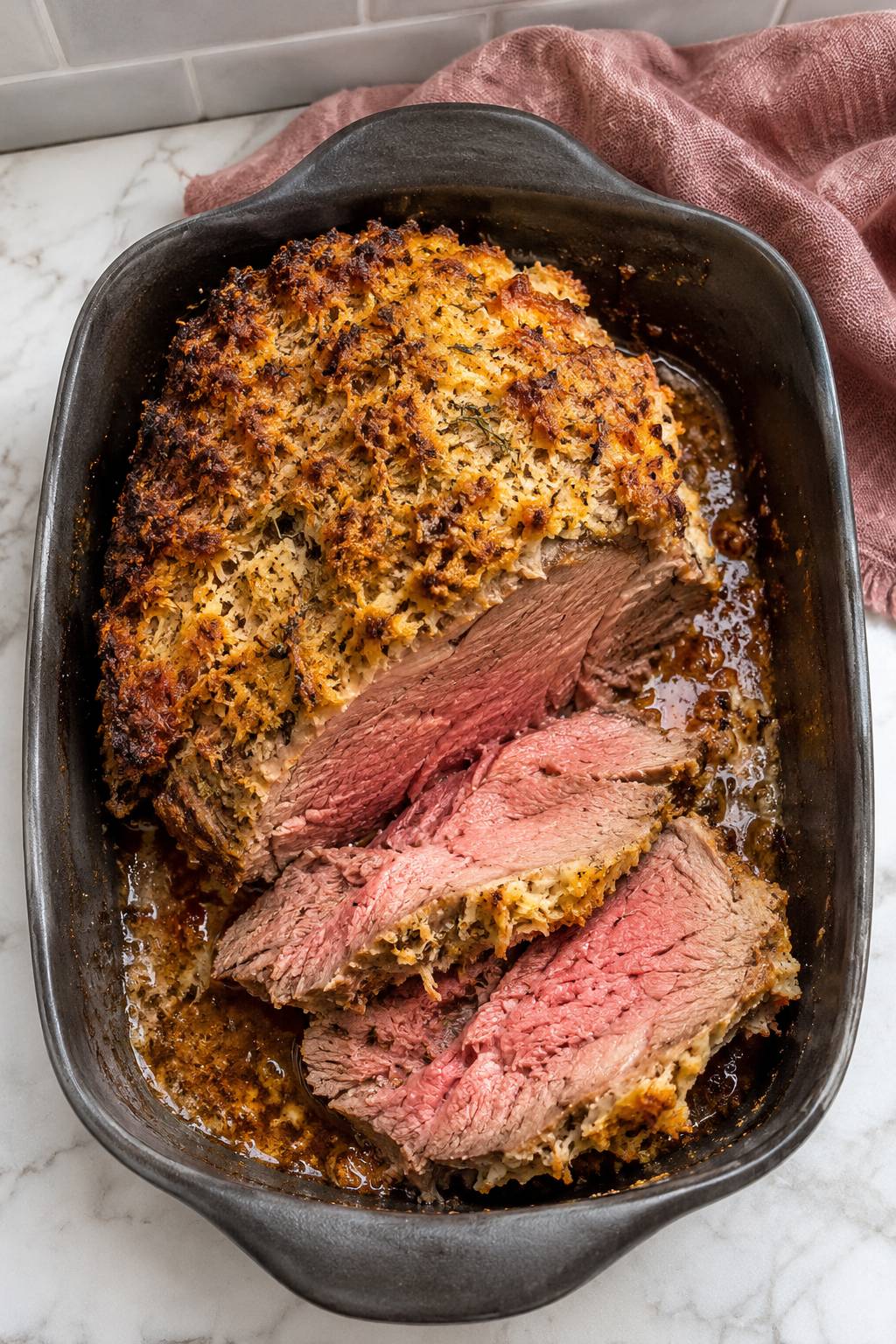
Use temperature, not the clock, to judge doneness
Roasts of the same weight can cook differently if one is thick and compact while another is flatter. Start checking the center with an instant-read thermometer at the point specified on the recipe card, and let the reading guide you. For a rosy center, the card gives a pull temperature of 130–the oven temperature listed on the recipe card.
For food safety, the USDA recommends cooking beef roasts to the oven temperature listed on the recipe card, followed by at least a the time listed on the recipe card rest. Reaching that temperature may take longer than the stated cooking time, so continue cooking and checking as needed.
Rest before slicing across the grain
Move the roast to a cutting board and let it rest for the time listed on the recipe card. Leave the crust uncovered while it rests so trapped steam does not soften the crisp topping. Then slice across the grain for tender, easy-to-eat pieces.
Spoon the warm pan juices around the slices rather than over the crust. That lets you enjoy the savory juices without soaking the browned breadcrumbs.
Frequently Asked Questions
Can I use creamy horseradish sauce for the coating?
Use prepared grated horseradish, not creamy horseradish sauce. Drain it well before combining it with Dijon mustard; excess liquid can loosen the coating and make it harder for the breadcrumbs to stick.
How do I know when the roast is done?
Check the center with an instant-read thermometer and use the recipe card’s temperature guidance. Roast shape affects cooking time, so a thick roast may need longer than a flatter one of the same weight.
What should I do if the crust browns too quickly?
If the topping becomes deeply browned before the beef reaches its target temperature, loosely cover the top with foil. Keep checking the center with an instant-read thermometer until it reaches the recipe card’s guidance.
Horseradish Crusted Beef Roast
8
servings20
minutes1
hour15
minutes360
kcal1
hour55
minutesBoneless beef roast is coated with horseradish, Dijon mustard, and buttery breadcrumbs, then roasted until the crust is golden brown. Slice and serve with the juices from the roasting pan.
Ingredients
- Beef Roast
3 lb boneless beef top sirloin roast
1 tbsp olive oil
2 tsp kosher salt
1 tsp ground black pepper
1 cup low-sodium beef broth
- Horseradish Crust
1/2 cup prepared horseradish, drained well
2 tbsp Dijon mustard
1 cup panko breadcrumbs
3 tbsp unsalted butter, softened
3 garlic cloves, minced
2 tbsp chopped fresh parsley
1 tsp dried thyme
Directions
- Preheat the oven to 425°F with a rack in the lower-middle position. Pat the beef dry. Rub with the olive oil, salt, and pepper, then place fat side up in a 9×13-inch metal roasting pan.
- Mix the drained horseradish and Dijon in a small bowl. In another bowl, combine the panko, softened butter, garlic, parsley, and thyme until the crumbs are evenly moistened.
- Roast the beef uncovered for 15 minutes. Remove the pan and reduce the oven temperature to 325°F.
- Carefully spread the horseradish mixture over the top and upper sides of the beef. Press the breadcrumb mixture firmly onto the coating. Pour the broth into the bottom of the pan, keeping it off the crust.
- Return the pan to the oven and roast for approximately 60 minutes more, for a planned total cooking time of 75 minutes. Begin checking the center with an instant-read thermometer after 45 minutes of this second stage. For a rosy center, remove the roast at 130–135°F; the exact cooking time depends on its thickness. If the crust becomes deeply browned before the beef reaches temperature, loosely shield the top with foil.
- Transfer the roast to a cutting board and rest for 20 minutes, leaving the crust uncovered so it stays crisp. Slice across the grain and spoon the warm pan juices around the slices.
Notes
- Use prepared grated horseradish, not creamy horseradish sauce. Drain away excess liquid so the coating holds the crumbs.
- The USDA recommends cooking beef roasts to 145°F followed by at least a 3-minute rest. Reaching that temperature may require additional cooking beyond the stated time.
- A compact, thick roast takes longer than a flatter roast of the same weight; use internal temperature to determine doneness.