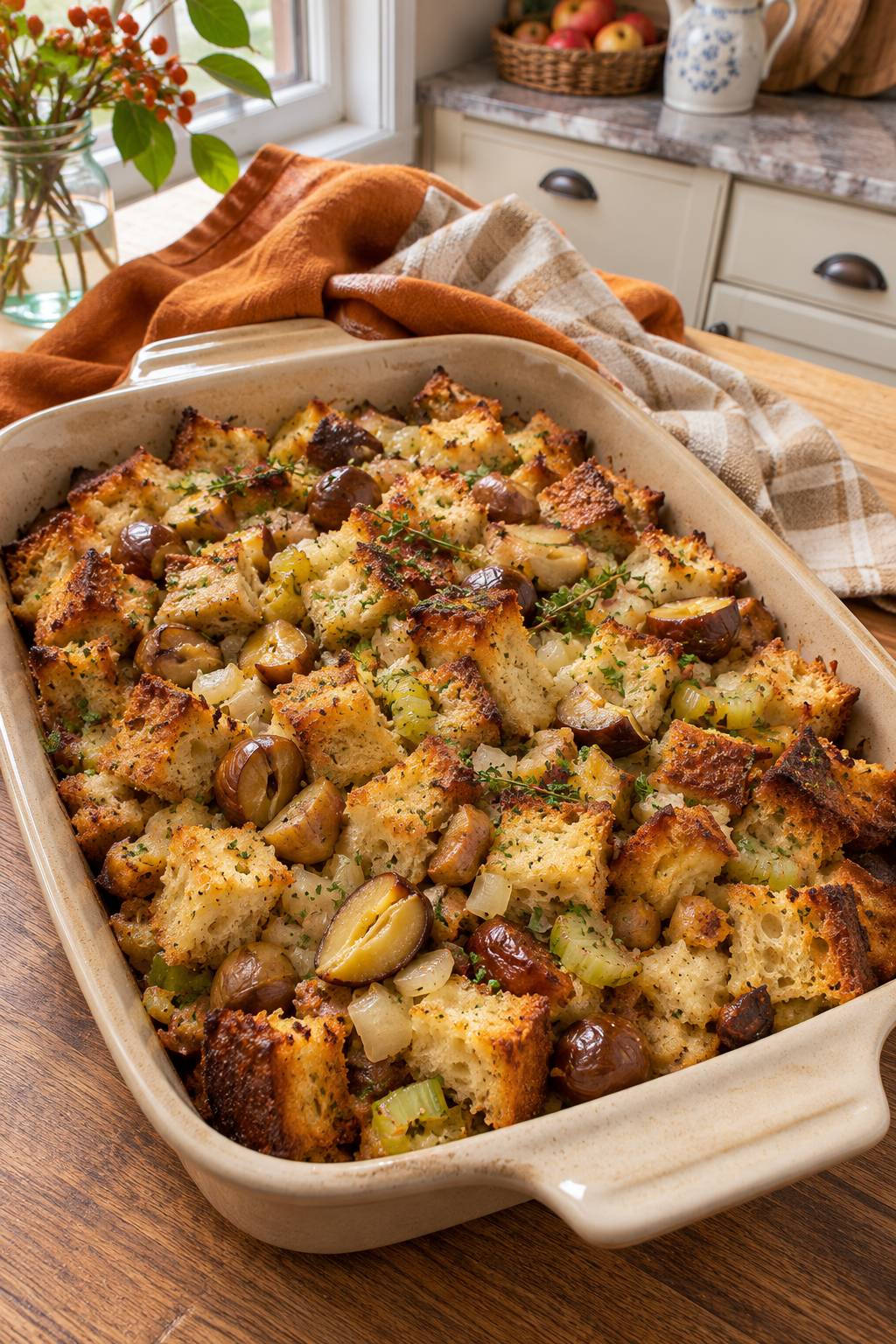
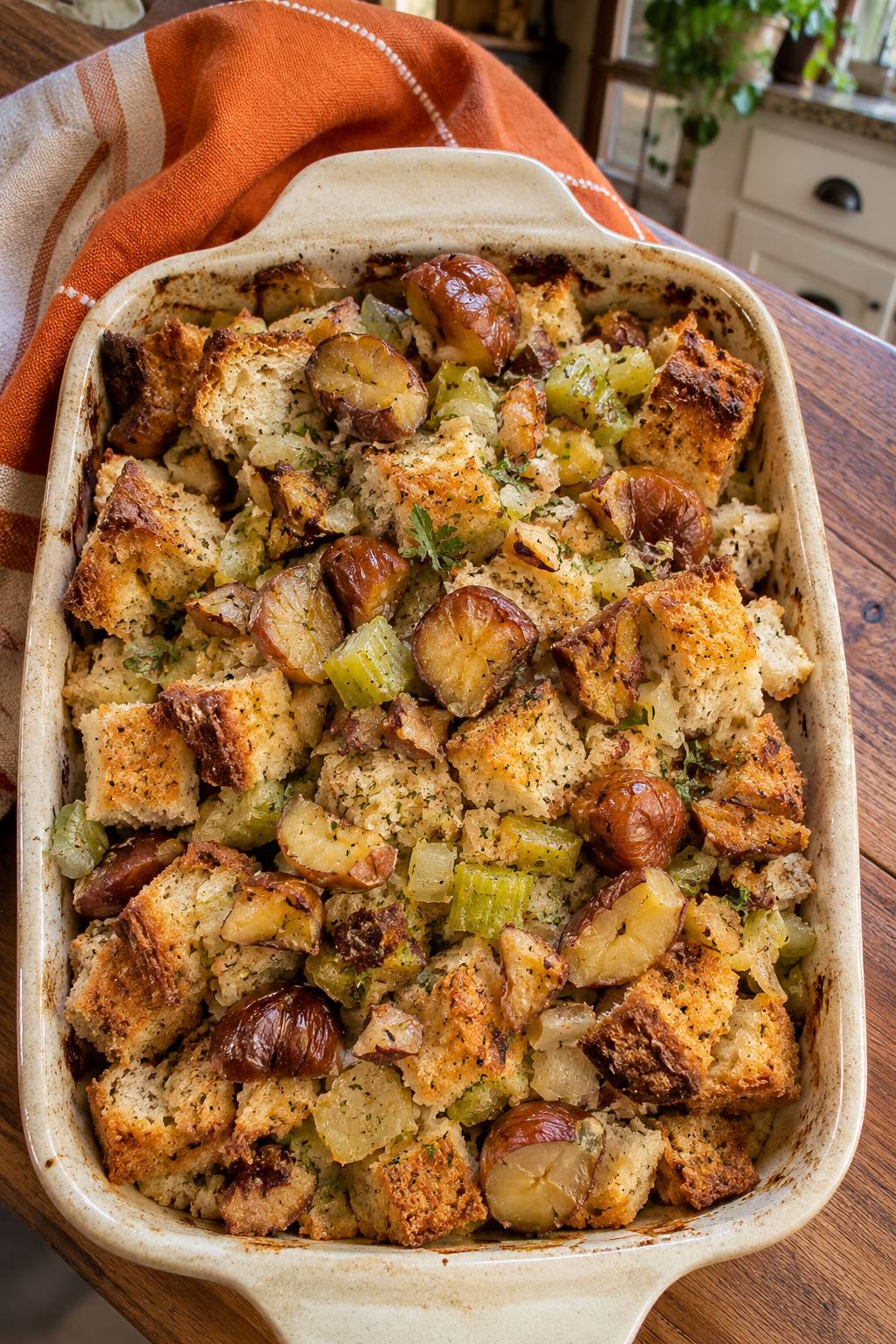
The corner pieces are worth claiming in this chestnut stuffing. The country bread turns golden and crisp where it meets the casserole dish, while the cubes in the middle stay tender. Roasted chestnuts give the stuffing a mellow sweetness that goes well with the buttery onions and celery. Fresh sage and thyme bring the familiar savory flavor you want in a holiday stuffing.
How to tell when the bread is toasted enough
Crusty country white bread gives you cubes that hold their shape when you toss them with broth. As they toast, pay attention to how they feel as well as how they look. The cubes should feel dry and look lightly golden. If they still feel soft, the color alone can fool you, especially on cubes with plenty of crust.
Give the bread room on the baking sheets so the cubes dry evenly. Where the cubes crowd together, the surfaces that touch can stay soft. Evenly toasted bread makes it easier to judge the broth later because you have fewer soft cubes mixed in with dry ones.
Keep the chestnuts distinct
Look for cooked, peeled roasted chestnuts in a vacuum-sealed pouch. They’re ready to use once you halve them, and the pieces are big enough to give you a distinct bite of chestnut among the bread cubes. Nestle the reserved chestnuts between the cubes on top so you can see them when the casserole comes out of the oven.
Let the onion and celery soften in the butter before adding the sage and thyme. That gives the vegetables a tender bite that fits the texture of the center. Fresh flat-leaf parsley goes in with the toasted bread, where its bright flavor comes through alongside the sage and thyme.
Judge the broth by feel
How much broth the bread takes up depends on how dry and dense the cubes are. The eggs, whisked with the broth, help the center hold together. Once you’ve tossed the bread with that mixture, check for dry patches before adding more broth. Add it gradually and toss gently after each addition so you can feel how much the cubes have absorbed without breaking them up.
Look at the bottom of the bowl as you toss. The cubes should feel evenly moistened, with no liquid collecting underneath. If the bread already feels evenly damp, stop there. Broth that pools in the bowl can leave the stuffing soggy.
Frequently Asked Questions
Why should I leave the stuffing loose in the casserole dish?
Spoon it in gently so the cubes keep their shape and the center stays tender. Pressing the bread down can make the middle dense. An uneven surface also leaves bread edges exposed so they can brown.
What does the foil do while the stuffing bakes?
The foil keeps the top from browning too early while the center cooks. Once you uncover the dish, the exposed bread can turn golden and crisp. The butter dotted over the top helps those exposed pieces brown.
How can I tell when the stuffing is done?
Look for a golden, crisp top, then check the center with a thermometer against the target on the recipe card. The surface can brown before the middle is ready. Let the stuffing rest as directed on the card before you scoop into it.
Chestnut Stuffing
10
servings20
minutes1
hour20
minutes270
kcal1
hour40
minutesRoasted chestnuts, buttery onions and celery, and fresh sage and thyme are folded into toasted country bread. The stuffing bakes in a casserole dish with crisp corners and a tender center.
Ingredients
1 lb crusty country white bread, cut into 1-inch cubes
8 tbsp unsalted butter, divided
1 large yellow onion, diced
3 celery stalks, sliced 1/4 inch thick
8 oz peeled roasted chestnuts, halved
1/4 cup chopped fresh flat-leaf parsley
1 tbsp finely chopped fresh sage
2 tsp fresh thyme leaves
1 tsp kosher salt
1/2 tsp ground black pepper
3 cups low-sodium vegetable broth, divided
2 large eggs
Directions
- Preheat the oven to 325°F. Grease a 9×13-inch baking dish with 1 tbsp of the butter. Spread the bread cubes in a single layer on two rimmed baking sheets. Bake for 25 minutes, stirring the cubes and switching the pans between racks halfway through, until the bread feels dry and is lightly golden.
- During the last 10 minutes of toasting, melt 6 tbsp of the butter in a large skillet over medium heat. Add the onion and celery and cook for 9 minutes, stirring occasionally, until softened. Stir in the sage, thyme, salt, and pepper and cook for 1 minute.
- Increase the oven temperature to 375°F. Transfer the toasted bread to a large bowl. Add the onion mixture, parsley, and most of the chestnuts, setting a handful aside for the top. Whisk the eggs with 2 1/2 cups of the broth. Pour over the bread and toss gently. If the bread still feels dry in spots, add the remaining broth a little at a time until the cubes are evenly moistened and no liquid pools in the bowl.
- Spoon the stuffing into the prepared dish without packing it down. Tuck the reserved chestnuts between the bread cubes and dot the top with the remaining 1 tbsp butter. Cover with foil and bake for 25 minutes. Remove the foil and bake for 20 minutes more, until the top is golden and crisp and the center reaches 165°F. Let rest for 10 minutes before serving.
Notes
- Use cooked, peeled chestnuts from a vacuum-sealed pouch. Halve them so you get distinct bites of chestnut throughout the stuffing.
- The amount of broth you need depends on how dry and dense the bread is. Toss well after each addition so you can judge how much the cubes have absorbed.