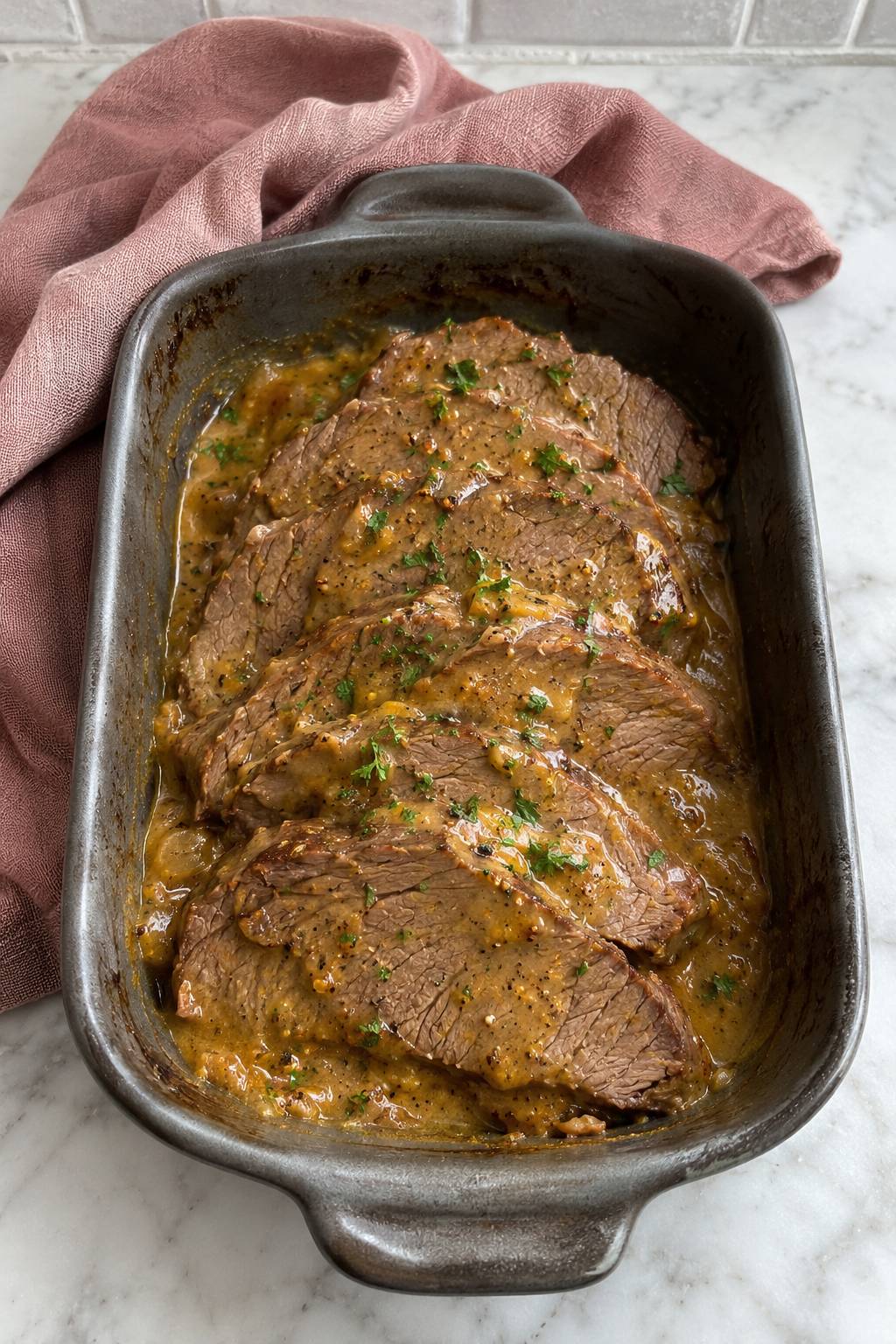
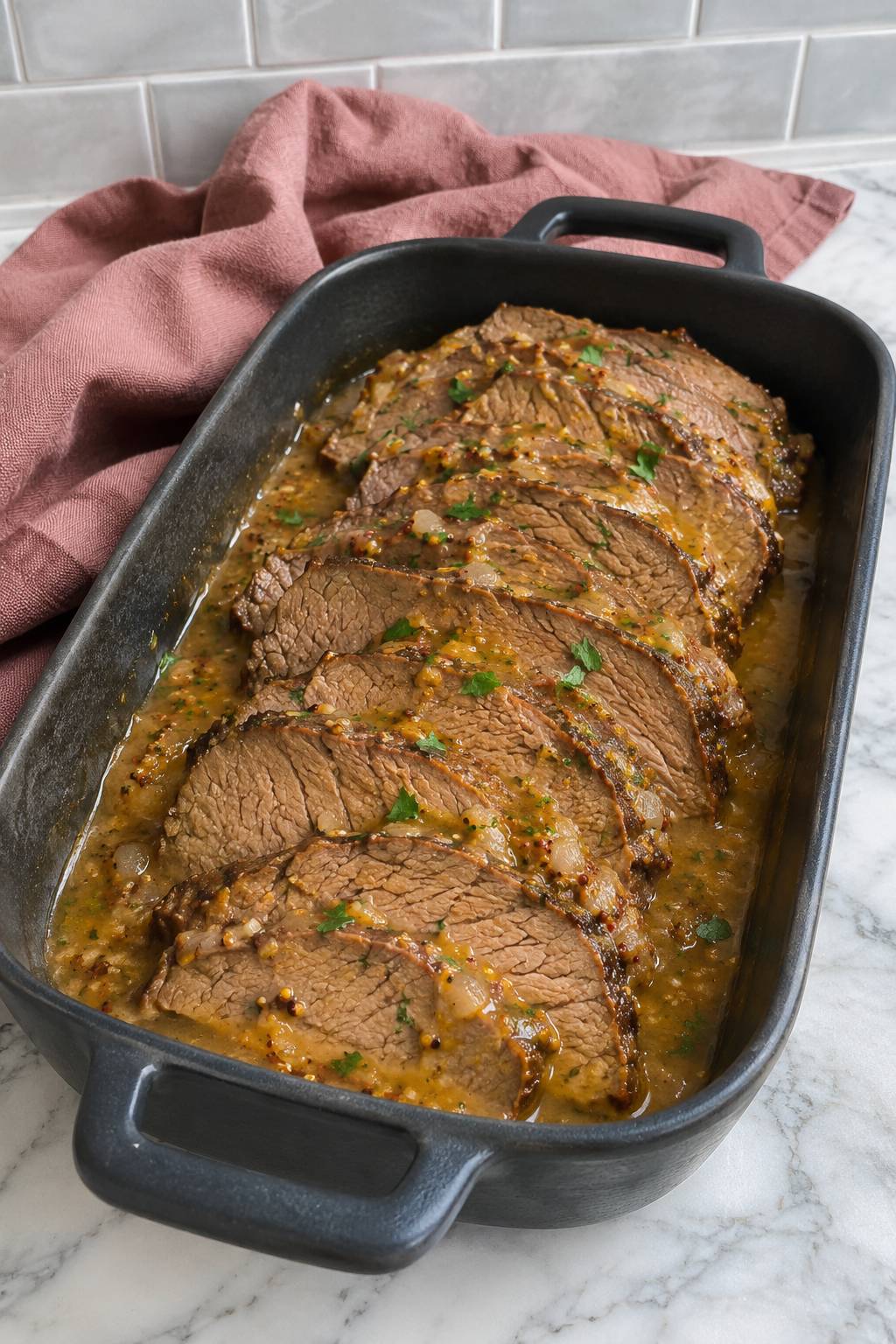
Mustard-Braised Bottom Round gives you tender slices of beef rather than a roast that falls apart when you cut it. The gravy is as much a part of the dish as the beef: softened yellow onion gives it body, yellow mustard brings a tangy edge, and fresh parsley adds a bright finish. The recipe card gives you the timing, but the color of the sear, the feel of a fork, and the way the gravy coats a spoon tell you what to look for.
Look for a deep sear, not a pale crust
Patting the roast dry with paper towels helps you get a well-browned surface. Pay attention to the sides as well as the broad faces; it’s easy to turn the roast as soon as you see some color and leave much of the surface pale. The browned bits left behind in the Dutch oven are worth keeping. When you pour in the beef broth, scrape the bottom of the pot so those bits go into the braising liquid, where they add the savory flavor you want in the finished gravy.
What each mustard brings to the gravy
Ground mustard goes in with the garlic and dried thyme, giving the gravy a deeper mustard flavor. Yellow mustard goes into the broth and brings the brighter tang you’ll notice when you taste it. The onion balances that tang without disappearing into the sauce. Aim for slices that are softened and lightly golden, not deeply browned. You’ll still see them in the finished gravy, where they’re tender enough to drape over the beef rather than sit stiffly on top.
Aim for fork-tender beef that still slices
A tight-fitting lid keeps the braising liquid from reducing too much while the beef cooks. To judge the roast, slide a fork into the thickest part. A thin edge may feel tender even when the center is still firm. You’re looking for little resistance, not for the beef to fall apart. Once the roast has rested under a loose foil tent, slice across the grain and keep the slices evenly thick. Cutting with the grain leaves long muscle fibers intact, which can make even a tender roast feel chewy.
Stop when the gravy coats a spoon
Skim off excess fat before thickening so the gravy doesn’t leave a greasy slick on the plate. Stir the cornstarch into cold water until smooth rather than adding it dry to the braising liquid, where it can clump. Whisk the slurry into the simmering liquid and watch how the gravy behaves on the back of a spoon. It should leave an even coating and still flow easily enough to spoon over the slices. The onions already give it some texture, so there’s no need to reduce it to a thick paste.
Frequently Asked Questions
How can I tell which way the grain runs?
Look at the raw roast before you sear it. The grain is the direction of the visible muscle fibers, which look like lines running along the meat. Note which way they run so you’ll know how to position the roast for slicing.
Why does the recipe call for low-sodium beef broth?
You season the roast with kosher salt before searing, and the broth becomes the base of the gravy. Low-sodium broth keeps the broth from contributing too much salt, leaving room for the mustard and onions to come through.
What if the roast is still firm when I check it?
Put the lid back on tightly and continue braising as directed on the recipe card. Check the thickest part again before taking the roast out to rest. If the fork still takes a push to go in, the beef isn’t ready to slice.
Mustard-Braised Bottom Round
8
servings20
minutes3
hours24
minutes290
kcal3
hours56
minutesA seared beef bottom round roast braises slowly with onions, beef broth, and mustard until tender enough to slice. Spoon the glossy mustard-onion gravy over the slices and finish with chopped parsley.
Ingredients
- Roast and Braising Liquid
3 lb beef bottom round roast
1 1/2 tsp kosher salt
1 tsp ground black pepper
2 tbsp olive oil
1 large yellow onion, thinly sliced
3 cloves garlic, minced
2 cups low-sodium beef broth
2 tbsp yellow mustard
1 tsp ground mustard
1/2 tsp dried thyme
- Gravy and Garnish
1 tbsp plus 1 tsp cornstarch
2 tbsp cold water
2 tbsp chopped fresh parsley
Directions
- Braise the Beef
- Preheat the oven to 300°F. Pat the roast dry with paper towels and season it all over with the salt and pepper.
- Heat the olive oil in a Dutch oven over medium-high heat. Sear the roast on all sides until well browned, about 10 minutes total. Transfer it to a plate.
- Reduce the heat to medium. Add the onion and cook for 7 minutes, stirring occasionally, until softened and lightly golden. Stir in the garlic, ground mustard, and thyme and cook for 1 minute.
- Pour in the broth and scrape up the browned bits from the bottom of the pot. Stir in the yellow mustard, then return the roast and any juices from the plate. Bring the liquid to a gentle simmer, about 3 minutes.
- Cover the pot tightly and transfer it to the oven. Braise for 3 hours, until a fork slides into the thickest part of the roast with little resistance. If the meat still feels firm, cover and braise for another 15 to 20 minutes before checking again.
- Finish and Serve
- Transfer the roast to a cutting board, tent loosely with foil, and let rest for 15 minutes. While it rests, skim any excess fat from the braising liquid. Stir the cornstarch and cold water together until smooth. Bring the liquid to a simmer over medium heat, whisk in the slurry, and simmer, stirring, until the gravy coats the back of a spoon, about 3 minutes total.
- Slice the roast about 1/4 inch thick across the grain. Arrange the slices in a shallow serving dish, spoon the onion gravy over them, and sprinkle with parsley.
Notes
- Check which way the grain runs before searing the roast. The muscle fibers are easier to see on the raw beef, and slicing across them makes each bite easier to chew.